COMMUNIQUÉ OF THE 17TH GENERAL ASSEMBLY OF THE ORGANISATION OF AFRICAN GEOLOGICAL SURVEYS (OAGS) HELD IN ENTEBBE, UGANDA BETWEEN 19 AND 21 NOVEMBER 2025
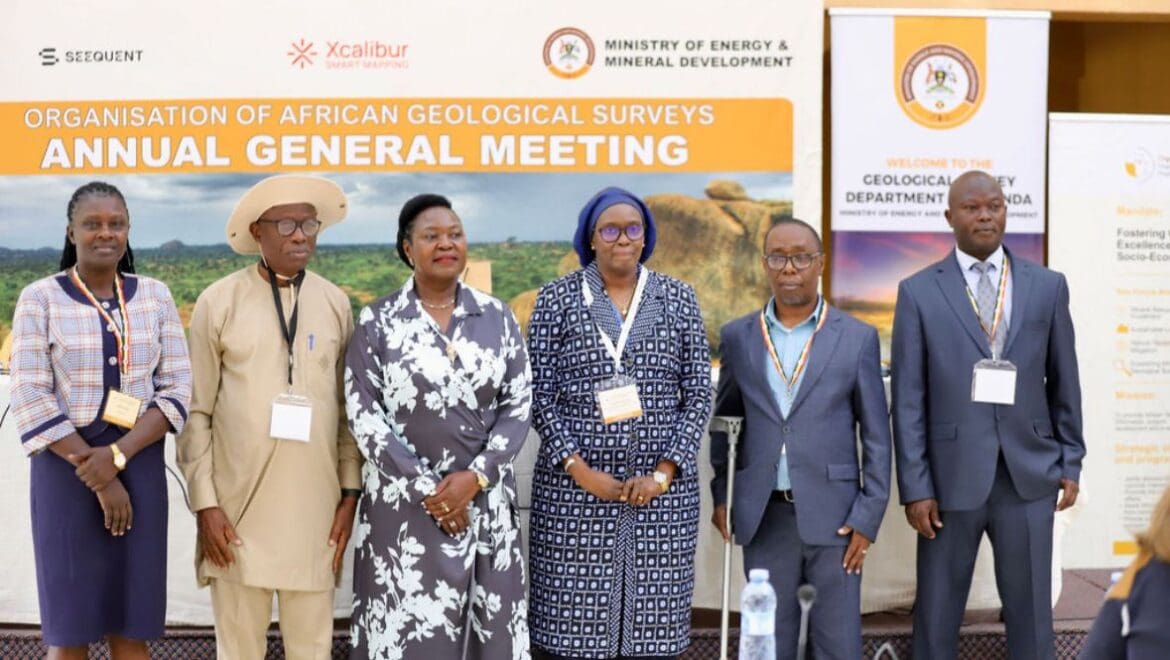
- The Organisation of African Geological Surveys (OAGS) held its hybrid 17th General Assembly (GA) from 19 to 21 November 2025, which served as an elective conference, at the Imperial Golf View Hotel, Entebbe, Uganda. The GA was interpreted in the official languages of the OAGS, including English, French, and Portuguese. The GA Heads of African Geological Surveys or their respective representatives who attended in person ranged from Algeria (Vice President – Northern Region), Angola, Burundi, Côte d’Ivoire, Democratic Republic of Congo, Kingdom of Eswatini, Kingdom of Lesotho, Mozambique, Namibia (Vice President – Southern Region), Senegal (President), South Africa (Permanent Secretariat) to Uganda (Vice President – Eastern Region).
- The Heads of African Geological Surveys or their respective representatives of Botswana, Burkina Faso (Vice President – Western Region), Central African Republic (Vice President – Central Region), Chad, Egypt, Ghana, Guinea Republic, Liberia, Madagascar, Niger, São Tomé and Príncipe, Sierra Leone, South Sudan, The Gambia, Togo Republic and Zimbabwe participatedvirtually.
- The Presiding Chairperson welcomed and acknowledged participation of partners, including the representative of the African Minerals Development Centre (AMDC), Minerals Africa Development Institution (MADI), representatives of the European Geological Surveys (EGS) – led by the President, Geological Society of Africa (GSAf), China Geological Survey, and private-sector companies Xcalibur, and Seequent.
- The host Minister was supported by the OAGS Vice President – Eastern Region, including the protagonists of the Commissioner of Energy and Mineral Development.
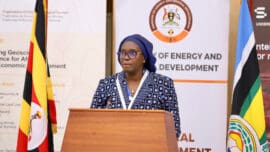
- The President of the OAGS, Dr Rokhaya Samba Diene, acknowledged the presence of the Hon. Minister, Canon Dr Ruth Nankabirwa Ssentamu, OAGS members and the Permanent Secretariat, and partners of the OAGS for their participation. In her report, she appreciated the role of geological surveys as providers of fundamental geoscientific evidence, on the basis of which critical decisions are to be made by individuals, nations, and the continent as a whole, in an ever-changing geo-political environment. Accordingly, as we look to the future, the organisation continues to build on the foundation of knowledge that will empower Africa to manage its natural resources sustainably, create value for its people, and safeguard its environment for generations to come.
- The OAGS President pronounced on the position to support the Prime Minister of Barbados in her capacity as the Chairperson of the Caribbean Community – as part of expanding the African base in solidarity, providing the geoscientific community with the responsibility to leverage each other’s strength in redefining the developmental trajectory as outlined in the African Union’s vision Agenda 2063.
- Reflecting on her two tenures as President, she highlighted some of the most salient milestones:
- The establishment of the OAGS as a Non-Profit Company (NPC) under the statutes of South African legislation, with South Africa retained as Permanent Secretariat, enabling the full operationalisation of the organisation.
- The establishment of synergistic relations, which gained recognition status with the African Union as a strategic partner, re-affirming the role of geoscience as a central force in advancing Africa’s developmental imperatives.
- The establishment of the OAGS Technical Committee, serving as the vehicle through which life will be breathed into the deployment of its scientific programme – this has gained exponential traction in shaping the organisation’s strategic direction.
- The continued development of the established relationship with the EU, which is perceptibly summiting its maturity status, necessitating an assessment of the prevailing posture and to determine its renewed life cycle.
- She further emphasised that this year’s GA elective conference marks a significant milestone that will chart the way for the new leadership to steer the organisation to new heights, and that this builds on a strong foundation laid by the incumbent leadership with the support of the Regional Vice-Presidents, spanning the Central, Eastern, Northern, Southern, and Western regions. Additionally, she noted that the GA was being held in the Eastern Region for the first time since 2020, with the other General Assembly’s rotating in the other regions over the years. She reaffirmed the OAGS’s mandate to foster and sustain geoscience programmes and excellence in Africa in pursuit of socio-economic development and poverty alleviation, with special reference to mineral resource assessment, sustainable land use and development, and environmental protection.
- Given the rising demand for geology as a focal instrument in addressing the socio-economic challenges of Africa, the President called on geological surveys to uphold their responsibility to alleviate the plight of the African child. She asserted that the Continent is riddled with the challenges of climate change, food security, energy security, infrastructure development, and mineral resource development, which can be addressed by placing fundamental geoscientific knowledge at the forefront.
- In closing, the President appreciated the institutional collaboration that has strengthened the Continent and the role of OAGS in developing Africa over the years. In the ever-changing geo-political landscape, the organisation continues to explore collaboration with strategic partners, such as the China Geological Survey located in the context of the Forum on China-Africa Cooperation (FOCAC), to advance developmental imperatives that are aligned with the Agenda 2063 and OAGS Strategy.
- Dr Arisekola Tunde, Director of African Minerals Development Centre (AMDC), presented on the role played by the AMDC, an African Union body responsible for promoting transparent, equitable, and optimal utilisation of Africa’s mineral resources to support broad-based sustainable growth and socio-economic development. Additionally, he encouraged collaboration among Member States to realise the untapped potential within the Continent. In his presentation, Dr Tunde implored members to be signatory to the AMDC statutes which is designed to deepen the commitment of implementing the Africa Mining Vision to help African countries to determine their progress toward realising our transformative ambitions.
- The Ugandan Ministry of Energy and Mineral Development, represented by Ms Agnes Alaba, Commissioner of Mines, addressed the delegates on behalf of ENG. Irene Pauline Beteebe in her capacity as the Permanent Secretary, introducing Honourable Minister of Energy and Mineral Development Resources, Canon Dr Ruth Nankabirwa Ssentamu, who graced the GA.
- Ms Alaba acknowledged that geological surveys have a stronger and more unified voice when they work together to use science as a tool for transforming African nations. Accordingly, the Ugandan government has outlined its priorities to meet energy need to transition towards clean energy and developing the mineral sector as a key economic pillar – ensuring that oil and gas resources create lasting value and reduce poverty. She affirmed that the Ugandan Cabinet resolved that agriculture, tourism and mineral development (“ATM”) serve as key sectors to drive economic transformation.
- In her keynote address, the Honourable Minister appreciated the importance of the geology in the African Continent and reaffirmed her support to the OAGS, as it will drive and encourage investment in exploration. As such, she recognised geology as a weapon that can liberate Africa, given that geology has no boundaries and has the primary mandate to protect the planet and to advance the developmental agenda. Uganda has been determined to understand the country’s geology by undertaking ground and airborne geophysical surveys covering 100% of the country, which have shown positive results that attracted exploitation of both petroleum resource development and mineral exploration in Uganda. She affirmed the Ugandan government’s commitment to support the geological sector through policies, legal frameworks, and regulatory systems.
- The Minister acknowledged that these ambitions will not be realised if the country does not invest in infrastructure such as analytical research facilities serving as an instrument to boost confidence of the investors. The Minister has tabled the proposition to have artisanal miners formalised – this has led to the demarcation of land that is specifically reserved for artisanal and small-scale mining who have been issued with mining licenses according to the enacted legislation.
- Hon. Minister declared the 17th GA officially opened.
- Ms Tirza van Daalen, President of the European Geological Surveys (EGS), presented on the structure and governance of the EGS with a focus on their 2023–2027 Strategy and the European Union’s critical minerals act for the sustainable clean-energy transition and economic development in the wake of climate change. She affirmed that European and African countries have worked side-by-side across a wide range of themes covering geoscientific mapping, mineral resource assessment, artisanal and small-scale mining, environmental management, geohazards, geoheritage, information management, communication and governance amongst others. This collaboration has taught the EU of the value of symbiotic relations.
- The EGS President reflected on the meeting held between the OAGS and EGS Presidents supported by the OAGS Secretary–General, affirming the need to streamline the relationship between Africa and Europe. She acknowledged that relationships are never smooth sailing as it has been evident in the EU-Africa cooperation – no matter how well you plan, the partners are bound to experience challenges. To this effect, she highlighted the resolution of directing the Secretaries General to present a proposal outlining the re-imagined relationship roadmap at the 2026 Mining Indaba for consideration by the Presidents.
- The EGS President emphasised the longstanding relationship with the OAGS, through which the first two phases of PanAfGeo programme had been implemented over the course of the last eight years, with the next phase of the programme – PanAfGeo+ – currently underway. She affirmed that the collaboration between the OAGS and EU is centred on local value addition, inclusive growth, and Environmental, Social and Governance (ESG) principles. It is up to the African members and European members to make sure that Agenda 2063 and the EU Global Gateway are used as a tool to guide development.
- Prof. Li Xiaoguang, Deputy Chief Engineer of the Tianjin Center, China Geological Survey, presented on the great importance that the China Geological Survey places on the cooperation with OAGS members and other geological organisations from the African Continent. As such, the China Geological Survey presented progress on the China-Southern Africa Region cooperation to demonstrate how geological data acquisition can support development. The presentation delved into the progress of initiatives implemented in Tanzania, Zambia and Zimbabwe.
- In his presentation, Prof. Gbenga Okunlola, President of Geological Society of Africa (GSAf), affirmed the responsibility placed on African leaders and institutions to drive the African Agenda for developmental imperatives. He further expressed his gratitude for the longstanding relationship between the GSAf and OAGS, which underpins the development of programmes for advancing the sustainable development of minerals. The GA acknowledged the GSAf’s efforts to decolonise African journals with a view to driving the African developmental agenda.
- Private sector partners presented the capabilities of their respective organisations to the geoscientific community – these presentations were delivered by:
- Mr Ben Young, Business Development Manager: Africa and Middle East Region at Xcalibur Smart Mapping.
- Mr Tshego Mojane, Business Development Coordinator supported by Mr Andrew Quixley, Business Development Manager: African and Middle East at Seequent.
- The GA recognised the importance of geoscientific data acquisition using tools such as geophysics and the application of digital transformation in advancement of closing geoscientific knowledge gaps.
- The host, Uganda Geological Survey Department, apprised participants of the geoscientific research being undertaken in the country, which comprises geology and mineral resources (including geothermal resource development and petroleum resources), geophysical data acquisition and applications, and developments around the legal and regulatory framework. This work illuminates the importance of investing in geology to advance socio-economic development imperatives.
- The GA welcomed the presentation on governance as part of the PanAfGeo+ project, presented by Mesdames Eva Terpstra and Tess Tjokrodikromo, representing the Geological Survey of Netherlands (TNO). This highlighted the necessity to align tailored work programme arising from work packages between EU and Africa.
- The GA amended its Constitution as part of its commitment to maintaining agility and adjustability in relation to the changing environment to enhance the efficacy of its governance structure.
- The GA welcomed the presentation of Dr Jean-Claude Guillaneau, focussing on the PanAfGeo+ programme which builds on the deployment of Phases 1 and 2. However, this brought into sharp focus the urgent necessity to give effect to the directive of the joint meeting of the OAGS and EGS Presidents for a strategic realignment between the two institutions.
- The GA noted and welcomed the progress made on the establishment of the Technical Committee to support the advancement of the organisational objectives. The GA accordingly noted the continued shaping of strategic research imperatives and capacitation of this structure. It further noted the creation of the Geochemistry Sub-Committee Experts, under the OAGS Technical Committee.
- The GA noted the Regional reports delivered by the respective Vice-Presidents.
- The GA adopted the OAGS Strategy as a blueprint of the African path (2025–2030).
- In keeping with the tradition of the Elections, the Secretariat received nominations from the members for the Presidency and Regional Vice Presidents and received nominations on the floor.
- The GA welcomed the appointment of the following members for the next three-year term in accordance with the Constitution, comprising:
- President: Uganda
- Vice President Central Region: Democratic Republic of Congo
- Vice President Eastern Region: Madagascar
- Vice President Northern Region: Algeria
- Vice President Southern Region: Mozambique
- Vice President Western Region: Ghana
- The GA congratulated the newly appointed President and Vice Presidents.
- The GA thanked the outgoing President, Dr Rokhaya Samba-Diane supported by the Vice Presidents: Mr Jules-César Yaganza (Central Region), Mr Gabriel Data (Eastern Region), Mr Karim Mokhtar (Northern Region), Ms Gloria Simubali (Southern Region) and Mr Abdoulaye Oudedraogo (Western Region). The outgoing President will continue to provide support and serve as an ex officio member of EXCOM for the next term.
- The President extended a word of appreciation to the Minister of Energy and Mineral Development, the government and the people of Uganda for their warm hospitality and culturally enriching reception in hosting the 17th General Assembly of the OAGS.
- The Gambia volunteered to host the 18th General Assembly of the OAGS in 2026.